
Short answer
Korea sorts household trash into three main streams: general waste in an official pay-per-bag bag (종량제 봉투), food waste in its own bin or bag, and recyclables separated by material. In a hotel you can ignore all of this, but in an Airbnb or guesthouse you are expected to sort. Rinse containers, keep food scraps out of the general bag, and follow your host's notes on where and when to take things out.
Quick facts
- General waste
- Official pay-per-bag bag only (종량제 봉투)
- Where to buy bags
- Convenience stores and supermarkets
- Food waste
- Separate bin or bag; no bones, shells or seeds
- Recyclables
- Rinsed and sorted: paper, cans, glass, plastic, vinyl
- Clear PET bottles
- Label off, crushed, in their own bag or slot
- Fine for wrong disposal
- Up to ₩1,000,000
Do I need to sort trash as a tourist in Korea?
It depends on where you sleep.
- Hotels: No. Use the bins in your room and housekeeping takes care of the rest.
- Airbnbs, apartment rentals, guesthouses and longer stays: Yes. You are living like a resident, and residents sort. Many hosts leave a short guide by the door, and some charge a cleaning penalty if trash is mixed.
Sorting is taken seriously in Korea. Seoul alone produces about 2,900 tonnes of household waste a day, and districts check what goes into the bags. Mixing waste or skipping the official bag can bring a fine of up to ₩1,000,000. As a short-term guest you are unlikely to be fined, but your host might be, so it is worth five minutes to get right.
The three main streams
| Stream | What goes in | How it leaves the home |
|---|---|---|
| General waste (일반쓰레기) | Things that can't be recycled or eaten: tissues, receipts, dirty wrappers, used chopsticks, toothbrushes | In an official pay-per-bag bag (종량제 봉투) for that district |
| Food waste (음식물쓰레기) | Leftover food, fruit and vegetable scraps, rice, noodles, cooked meat | In a food-waste bin or a special food-waste bag |
| Recyclables (재활용) | Paper, boxes, cans, glass bottles, plastic containers, vinyl wrappers, styrofoam | Rinsed and sorted by material into bins, bags or a collection point |
General waste and the official bags
General waste must go in a 종량제 봉투 (jongnyangje bongtu), the official bag of the district you are staying in. The price of the bag is the trash fee, so a small bag costs a few hundred won. You can buy them at convenience stores and supermarkets; ask for jongnyangje bongtu and the size, such as 10 or 20 liters. Bags from another district are not accepted, so don't bring them across town. Your host will often leave a few.
Food waste: the tricky one
Food waste becomes animal feed or compost, so the rule of thumb is: if an animal could eat it, it's food waste. That means some kitchen scraps are not food waste and belong in general waste:
- Chicken and pork bones, and fish bones
- Shells from clams, mussels, crab and eggs
- Hard seeds and pits from peaches, plums and avocados
- Onion and garlic skins, corn husks
- Tea bags and coffee grounds
Drain liquid before you throw food away. In apartment buildings, food waste usually goes into a shared bin at the collection point, sometimes with a chip card or sticker; in smaller houses it goes into a dedicated food-waste bag or container. Follow your host's note.
Recyclables
Recyclables don't need a paid bag, but they need to be clean and separated:
- Rinse containers. A yogurt cup with yogurt in it is general waste.
- Clear PET bottles (water, soda) are collected on their own: remove the label, crush the bottle and put the cap back on.
- Vinyl and plastic film (snack bags, wrappers) are a separate category from hard plastic.
- Flatten boxes and remove tape.
- Cans and glass bottles go in their own bins.
When and where to take trash out
- Apartment buildings usually have a collection point (분리수거장) in the basement or by the parking lot, often open around the clock, with labeled bins for each material.
- Houses and villas put trash out on the street on set days, usually in the evening before collection. Times differ by district and even by street, so follow the schedule your host gives you.
- Never leave bags on the street outside the set time, and never in front of someone else's house or shop.
Checking out with a bag still to throw away? Ask your host. Most would rather you leave a sorted bag by the door than mix everything into one.
Sorting on the go: recycling bins in the street
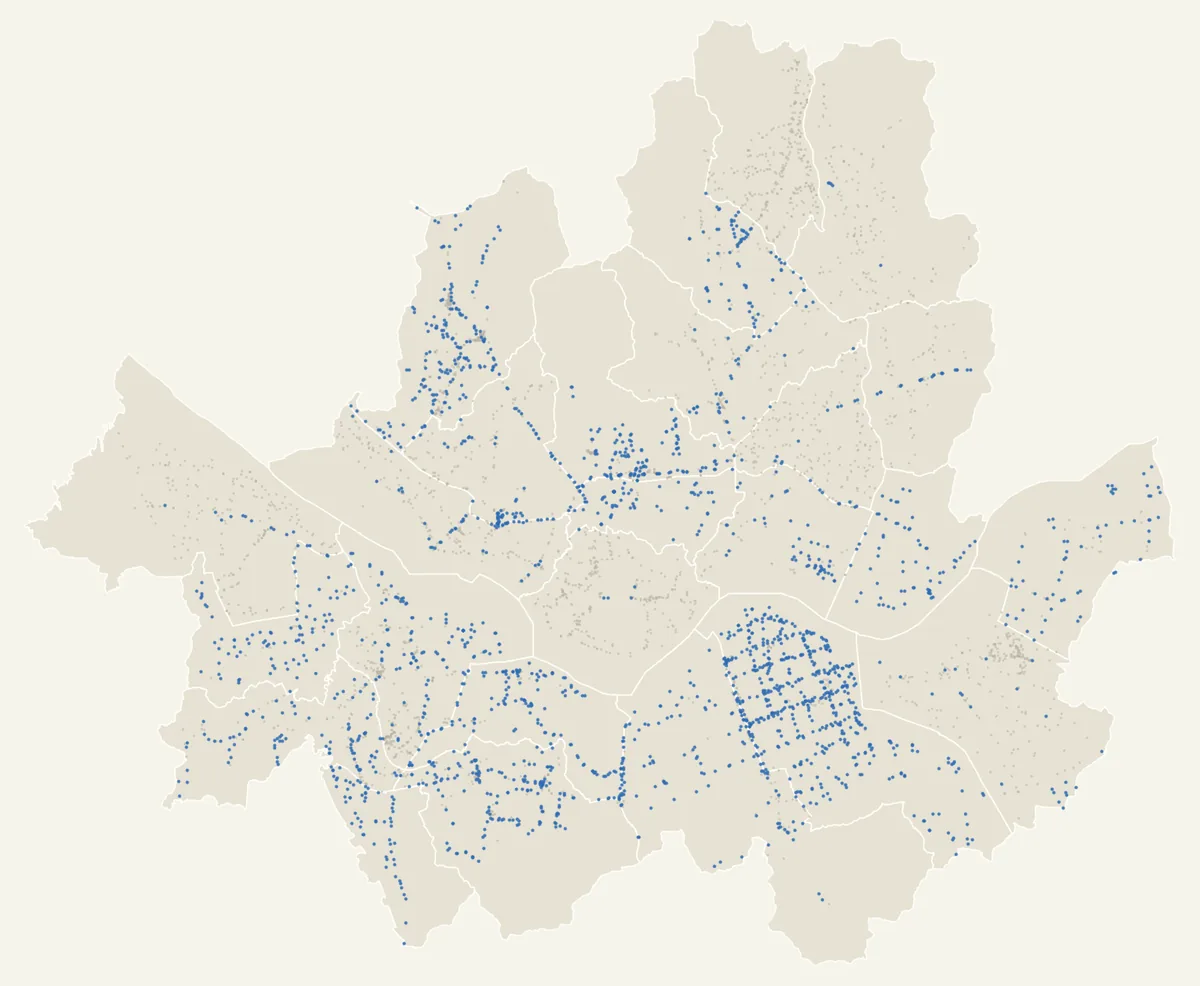
Outside, it is simpler. Many street bins in Seoul have two openings: general waste on one side and recyclables, such as cans and plastic bottles, on the other. TapSeoul maps 2,104 bins with a recycling side.
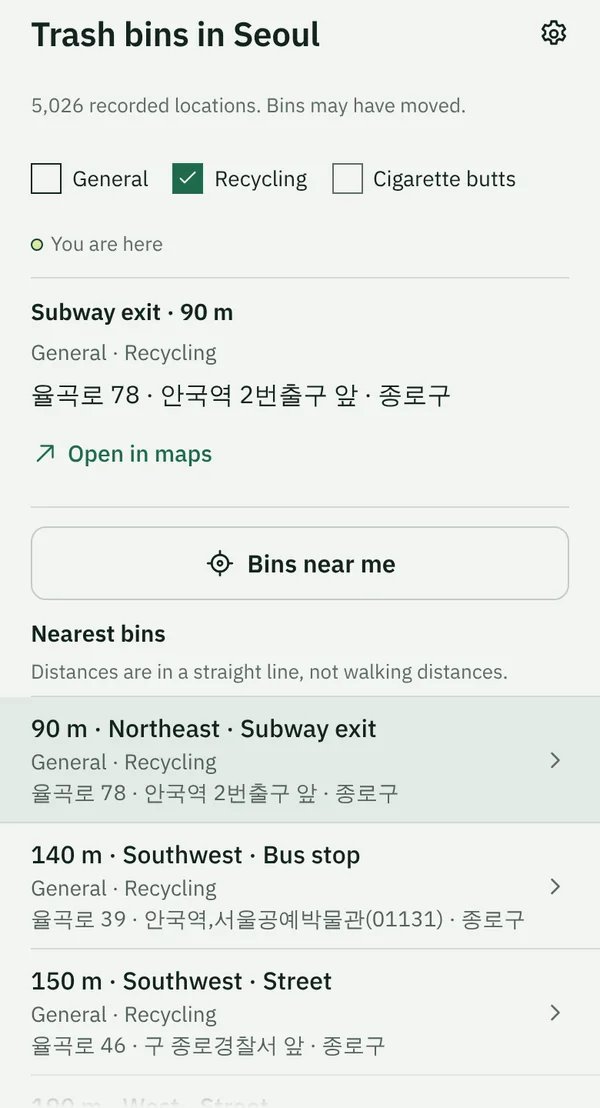
In the Trash tab, select Recycling to show only those bins, then tap Bins near me. TapSeoul checks your location once and lists the nearest ones, with the Korean address to show someone if you get lost.
Coffee cups and bottles you carry around are also easy to drop at a café or convenience store. More tips are in where to throw away trash in Seoul.
Common mistakes hosts see
- Using a regular plastic bag or a bag from another district for general waste.
- Putting bones, shells or tea bags in the food waste.
- Throwing out containers with food still inside.
- Putting delivery-food containers in recycling without rinsing them.
- Mixing clear PET bottles with other plastic.
- Leaving trash outside the door or on the street on the wrong day.
FAQ
What is a 종량제 봉투 (jongnyangje bongtu)?
It is the official pay-per-bag trash bag for general waste. Each district sells its own, and the price of the bag is the trash fee. You can buy them at convenience stores and supermarkets in the district where you are staying.
Are bones and eggshells food waste in Korea?
No. Bones, shellfish shells, eggshells, hard fruit pits, onion skins and tea bags go in general waste, because they can't be turned into animal feed.
Do I have to sort trash in a Korean hotel?
No. In a hotel, leave trash in your room's bins. Sorting is expected in Airbnbs, apartment rentals, guesthouses and longer stays.
Where do I put delivery-food containers?
Empty the leftovers into food waste, rinse the plastic containers and put them with recyclables. Paper that is soaked with sauce or oil goes in general waste.
When can I take out the trash?
In apartment buildings you can usually use the collection point at any time. Houses and villas put trash out on set days, usually in the evening. The schedule varies by district, so check your host's instructions.
Is there a fine for not sorting trash in Korea?
Yes. Districts can fine people for not using official bags or for mixing waste, with fines of up to ₩1,000,000. Visitors are rarely fined, but hosts can be, so follow their rules.
No account. Cards and visited places are stored only on your phone. Photos are processed on the device and never uploaded. Optional analytics stays off until you opt in.
Sources
- Jongno district launches picture-based recycling guides for foreign residents (The Korea Times, Oct 2026)
- One bag less: Seoul's waste reduction campaign (Seoul Metropolitan Government, Mar 2026)
- Volume-based waste fee system (National Archives of Korea)
- Seoul street trash bin installation data (Seoul Open Data Plaza)
Rules, fines and bin locations are as of October 2026 and can change. Check local signs and the official sources.