Short answer
Seoul has street trash bins, just not many: the city's open data lists about 6,800, for a city of more than nine million people. Most stand at bus stops, subway exits and busy shopping streets, often as a pair of slots for general waste and recyclables. If you can't see one, keep your trash until you pass a convenience store, café or subway station, and never leave it on top of a full bin. TapSeoul's Trash tab shows 5,026 mapped bins and finds the nearest one with a single location check.
Quick facts
- Street bins in Seoul (open data, Nov 2025)
- About 6,800
- Bins mapped in TapSeoul
- 5,026 locations
- Most common spot
- Bus stops (about 4 in 10 mapped bins)
- Why bins are rare
- Pay-per-bag waste system since 1995
- Fine for dropping a cigarette butt
- ₩50,000
- Household trash in a street bin
- Not allowed; it can be fined
Why are there so few trash cans in Seoul?
Almost every visitor notices it on day one: you finish a coffee or a snack in Seoul and there is nowhere to put the cup.
The reason goes back to 1995, when Korea introduced its volume-based waste fee system (종량제, jongnyangje). Households pay for their rubbish by buying official bags, so the more they throw away, the more they pay. Soon after, street bins began to fill up with household trash that people did not want to pay for, and cities removed many of them. Seoul had 7,607 street bins in 1995 and only 3,707 by 2007, according to the city.
The numbers have been climbing again. In 2023 the city set a target of 7,500 street bins by the end of 2025, focused on tourist areas and busy bus stops. Seoul's latest open data, from November 2025, lists about 6,800 bins across the 25 districts. That is still very few for a city of more than nine million people, and they are not spread evenly.
Where are the public trash bins?
TapSeoul maps 5,026 of those bins from Seoul Metropolitan Government and district open data. Here is where they stand:
| Location | Mapped bins | Share |
|---|---|---|
| Bus stops | 2,227 | 44% |
| Streets and sidewalks | 1,132 | 23% |
| Shopping and food streets | 672 | 13% |
| Subway exits | 494 | 10% |
| Parks | 179 | 4% |
| Other public spots | 322 | 6% |
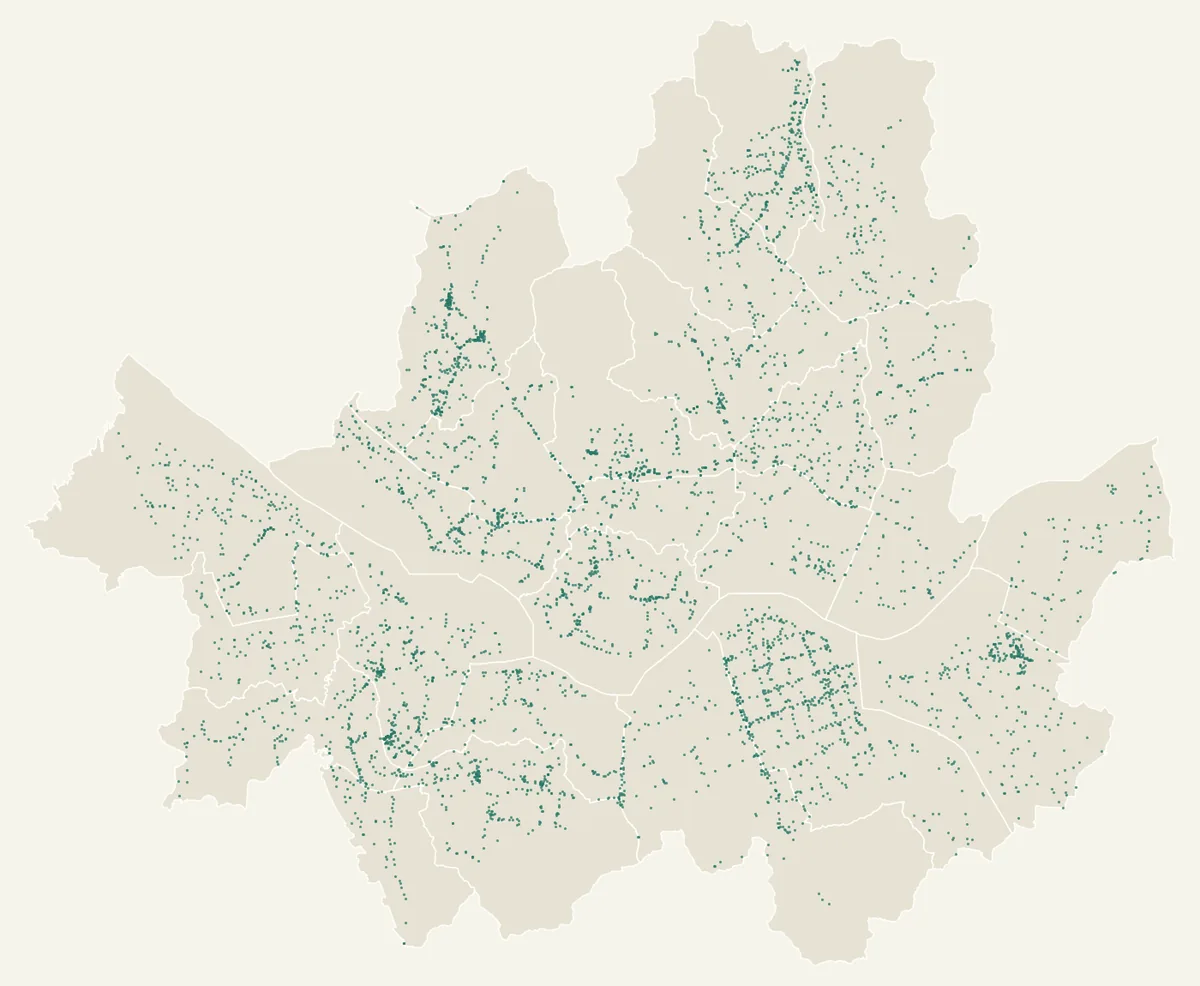
A few patterns help when you are out walking:
- Bus stops are your best bet. Especially the central bus lanes in the middle of big roads, such as near Hongik University Station.
- Subway exits often have a bin within a few steps of the stairs.
- Busy shopping and food streets get extra bins, and some districts add bins only for cigarette butts.
- Coverage depends on the district. Gangnam-gu has 541 mapped bins, while Jung-gu, home to Myeong-dong, has only 62 in the open data. Treat the map as a guide, not a promise.
Most street bins have two openings: one for general waste (일반쓰레기) and one for recyclables (재활용) such as cans and plastic bottles. Use the right side; collectors sort them separately.
No bin in sight? What to do with your trash
When there is nothing nearby, do what locals do:
- Carry a small bag. A spare plastic or zip bag in your day bag solves most problems.
- Take cups back to the café. Most cafés have a return shelf or bin for their own cups. Pour out the ice first.
- Use a convenience store. Most stores have a bin for things bought there. If you are buying a drink anyway, it is the easiest place to drop the wrapper.
- Wait for a subway station. Many stations have bins inside, often near the gates or restrooms.
- Use your hotel room. Rubbish from the day can go in your accommodation's bins. If you are in an apartment rental, see how to sort trash at your Airbnb.
What not to do:
- Don't leave trash on top of or next to a full bin. It counts as dumping, and it is the main reason residents complain about public bins.
- Don't put household bags in street bins. Street bins are for small items you carry while walking. Bags of household waste in public bins are exactly what the 1995 system was meant to stop, and districts can fine for it.
- Don't drop cigarette butts. That is a ₩50,000 fine. Some streets have butt bins; see smoking rules in Seoul.
How to find the nearest bin with TapSeoul
TapSeoul has a Trash tab just for this. It shows public trash bins in Seoul on a map and in a list.
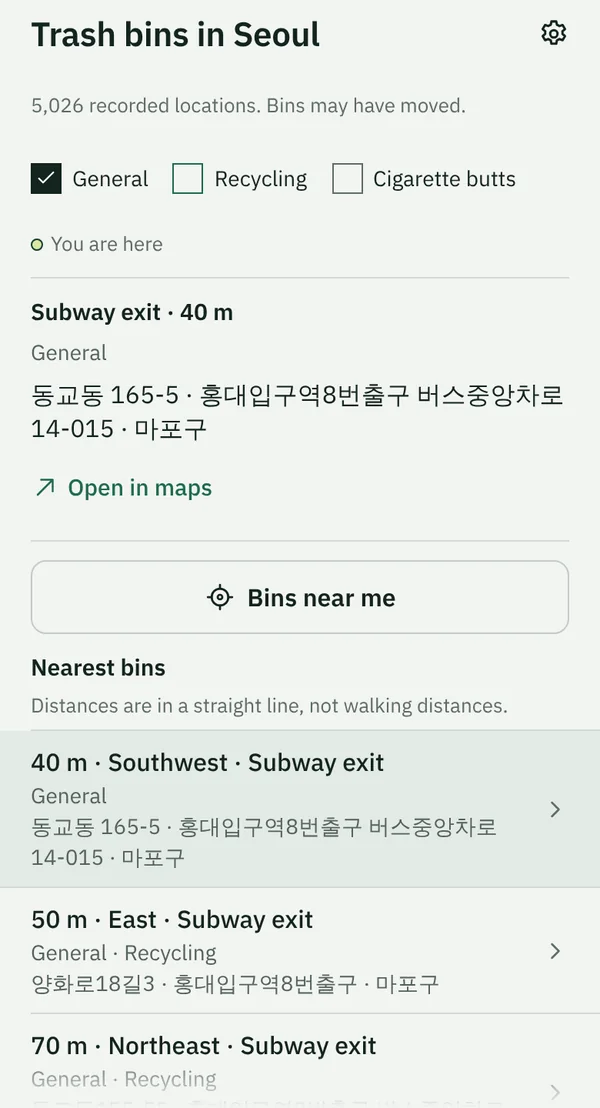
- Open the Trash tab. It starts with General selected.
- Tap Bins near me. TapSeoul checks your location once, only when you tap, and selects the nearest bin.
- Read the list: each bin shows the straight-line distance, the direction, the type of place (bus stop, subway exit, street) and its Korean address and description.
- Tap Open in maps to open the same address in NAVER Map or Google Maps for walking directions.
Turn on Recycling or Cigarette butts to see those bins too; the map and list show all the types you select. The bin locations are built into the app, so the list works even with a weak connection. Locations are approximate and bins sometimes move, so if a bin is not where the app says, check the next one on the list.
FAQ
Why are there no trash cans in Seoul?
There are some, but far fewer than in most big cities. After Korea started charging for household trash by the bag in 1995, people began dumping household waste in street bins, so many were removed. Seoul is slowly adding bins back, mainly at bus stops and in tourist areas.
How many public trash bins does Seoul have?
Seoul's open data from November 2025 lists about 6,800 street trash bins across its 25 districts. TapSeoul maps 5,026 of them with a location you can walk to.
Where can I throw away a coffee cup in Seoul?
Take it back to a café's return shelf, or use the general-waste side of a street bin at a bus stop or subway exit. Pour out any drink and ice first. Leaving cups on walls, steps or next to full bins counts as littering.
Can I use a convenience store trash can?
Most convenience stores keep a bin for items bought in the store, so it is fine to drop the packaging of what you just bought there. Don't empty a bag of trash from elsewhere into it.
Is there a fine for littering in Seoul?
Yes. Dropping a cigarette butt costs ₩50,000, and districts can fine people for dumping trash in the street or putting household waste in public bins. Larger cases of improper disposal can reach ₩1,000,000.
Do I need the internet to find a bin with TapSeoul?
The list of bins is stored in the app. TapSeoul checks your location once when you tap Bins near me, and only opening directions in NAVER Map or Google Maps needs a connection.
No account. Cards and visited places are stored only on your phone. Photos are processed on the device and never uploaded. Optional analytics stays off until you opt in.
Sources
- Seoul street trash bin installation data (Seoul Open Data Plaza)
- Seoul to manage street trash bins systematically (Seoul Metropolitan Government)
- Seoul to expand street trash bins to 7,500 (Dailian, Oct 2023)
- Street trash bins coming back after 30 years? (Seoul Shinmun, Sep 2024)
- Volume-based waste fee system (National Archives of Korea)
Rules, fines and bin locations are as of October 2026 and can change. Check local signs and the official sources.